Heat Transfer Basics MCQs

Welcome to our comprehensive collection of Multiple Choice Questions (MCQs) on Heat Transfer Basics, a fundamental topic in the field of Basic Chemical Engineering. Whether you're preparing for competitive exams, honing your problem-solving skills, or simply looking to enhance your abilities in this field, our Heat Transfer Basics MCQs are designed to help you grasp the core concepts and excel in solving problems.

In this section, you'll find a wide range of Heat Transfer Basics mcq questions that explore various aspects of Heat Transfer Basics problems. Each MCQ is crafted to challenge your understanding of Heat Transfer Basics principles, enabling you to refine your problem-solving techniques. Whether you're a student aiming to ace Basic Chemical Engineering tests, a job seeker preparing for interviews, or someone simply interested in sharpening their skills, our Heat Transfer Basics MCQs are your pathway to success in mastering this essential Basic Chemical Engineering topic.

Note: Each of the following question comes with multiple answer choices. Select the most appropriate option and test your understanding of Heat Transfer Basics. You can click on an option to test your knowledge before viewing the solution for a MCQ. Happy learning!

So, are you ready to put your Heat Transfer Basics knowledge to the test? Let's get started with our carefully curated MCQs!

Heat Transfer Basics MCQs | Page 1 of 53

Discover more Topics under Basic Chemical Engineering
Q1.
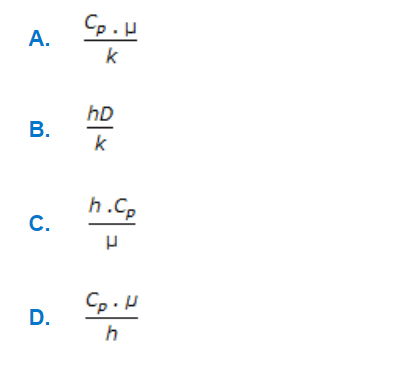
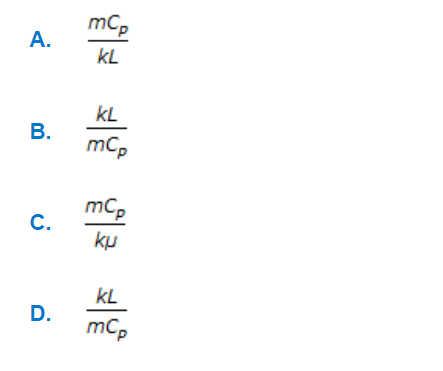
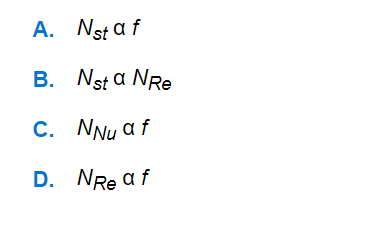
Reynold's analogy states that

a.

A

b.

B

c.

C

d.

D

Discuss
Answer: (a).A
Q2.
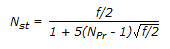
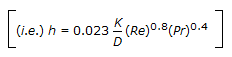
The following equation, corresponds to __________ analogy.
Discuss
Answer: (d).Prandtl
Q3.
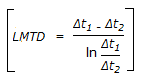
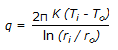
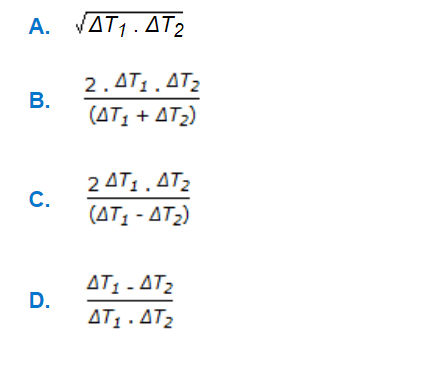
Out of the following four assumptions used in the derivation of the equation for LMTD given by below equation, which one is subject to the largest deviation in practice ?
Discuss
Answer: (b).Constant rate of fluid flow.
Q4.
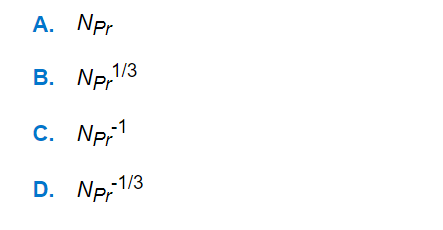
For flow over a flat plate, the ratio of thermal boundary layer thickness, 'xt' and hydrodynamic boundary layer thickness 'x' is equal to (where, NPr = Prandtl number)

a.

A

b.

B

c.

C

d.

D

Discuss
Answer: (b).B
Q5.
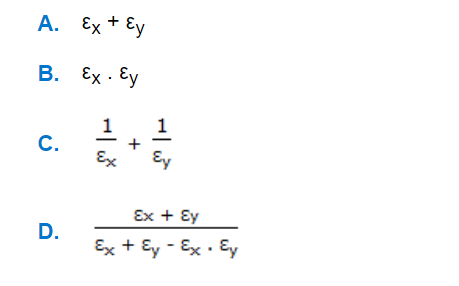
The interchange factor for radiation heat transfer from surface 'x' to surface 'y' in case of an infinite parallel planes with emis-sivities ฮตx & ฮตy is given by

a.

A

b.

B

c.

C

d.

D

Discuss
Answer: (d).D
Q6.
What is Nusselt number ?

a.

A

b.

B

c.

C

d.

D

Discuss
Answer: (b).B
Q7.
Hot water (0.01 m³ /min) enters the tube side of a counter current shell and tube heat exchanger at 80°C and leaves at 50°C. Cold oil (0.05 m³/min) of density 800 kg/m³ and specific heat of 2 kJ/kg.K enters at 20°C. The log mean temperature difference in °C is approximately
Discuss
Answer: (a).32
Discuss
Answer: (c).relieve stresses caused by thermal expansion.
Discuss
Answer: (d).boiling of a liquid on a hot surface.
Q10.
A process stream of dilute aqueous solution flowing at the rate of10 Kg.sโป¹ is to be heated. Steam condensate at 95°C is available for heating purpose, also at a rate of 10 Kg.sโป¹. A 1 - 1 shell and tube heat exchanger is available. The best arrangement is
Discuss
Answer: (a).counter flow with process stream on shell side.